
Insta360 X5 Review (2026): Specs, Price, Features & Is It Worth Buying?
The problem with 360 cameras was never the footage itself, it was everything around it. One careless drop and the bulging fisheye lenses were scratched beyond repair, turning an expensive camera into a paperweight. Night footage came out grainy and unusable, and batteries died long before the day did. The Insta360 X5, launched by Insta360 in April 2025 at $549.99, takes direct aim at all three weaknesses: user-replaceable lenses, dual 1/1.28-inch sensors for genuinely better low light, and a 2400mAh battery rated for up to 185 minutes of shooting. It records 8K 360 video, survives 15 meters underwater without a case, and Insta360 positions it as the toughest consumer 360 camera it has ever built. This review breaks down the Insta360 X5 specs, real-world performance, price, and the one question that matters: should you buy it, or save money with the older X4?
Insta360 X5 at a Glance
Short on time? This table gives you the complete Insta360 X5 spec sheet in one place. The detailed breakdown of each feature follows below.
| Specification | Insta360 X5 |
|---|---|
| Max 360 video | 8K at 30fps, 5.7K at 60fps |
| Single-lens mode | 4K at 60fps, slow motion up to 4K at 120fps |
| Sensors | Dual 1/1.28-inch sensors |
| Photo resolution | 72MP 360 photos |
| Battery | 2400mAh, up to 185 minutes in Endurance Mode |
| Fast charging | Roughly 80 percent in about 20 minutes |
| Waterproofing | IP68, 15 meters without a case |
| Lenses | User-replaceable (replacement kit around $30) |
| Weight | 200 grams |
| Low-light mode | PureVideo |
| Stabilization | FlowState with 360-degree horizon lock |
| Launch price | $549.99 |
What Is the Insta360 X5?
The Insta360 X5 is a dual-lens 360 camera. It captures everything around you at once in up to 8K, and after shooting you place a virtual camera anywhere inside that footage. You shoot first and frame later. Missed the moment your friend wiped out behind you? That footage is still in the file; you drag the view around in the app and export a normal-looking video.
That is the pitch of every 360 camera. What makes the Insta360 X5 different comes down to three hardware changes over the X4: dual 1/1.28-inch sensors (a large jump from the X4’s 1/2-inch chips), a triple AI chip for processing, and genuinely user-replaceable lenses. The first two give you cleaner footage, especially in poor light. The last one changes how you treat the camera, because you stop babying the most fragile part of it.
It helps to understand where the X5 sits in the market. Insta360 has owned the consumer 360 space since the X3, and the X4 in 2024 brought 8K recording to the mainstream. The X5 keeps that resolution and spends its upgrades on everything around it: light gathering, durability, battery, and sound. Its real competition is not another Insta360, it is the GoPro Max 2 and the decision to buy a normal action camera instead. A normal action camera makes you aim; the Insta360 X5 lets you stop aiming entirely, which is why solo creators keep choosing it.
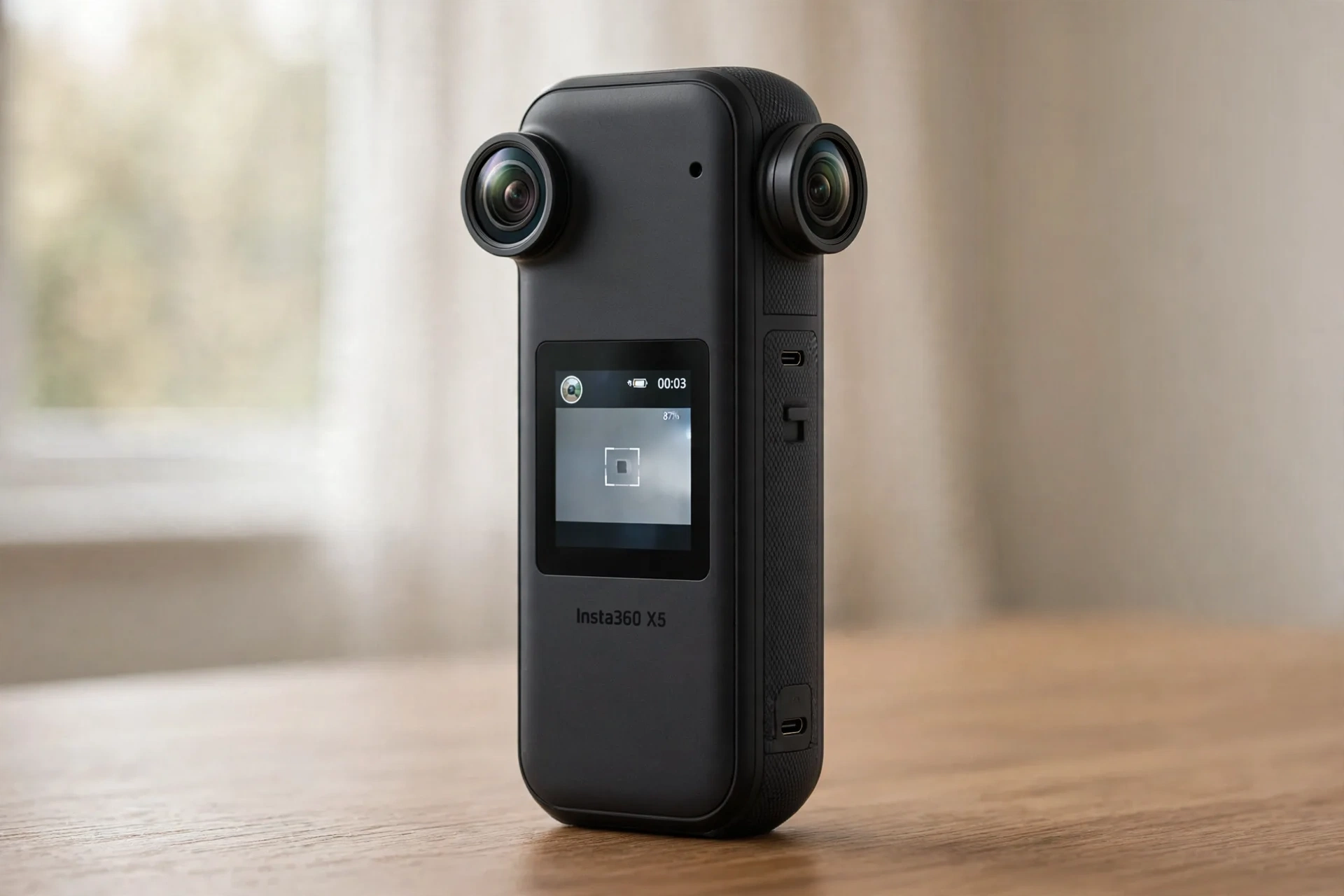
Insta360 X5 Design and Build Quality: Replaceable Lenses Change Everything
The Insta360 X5 keeps the candy-bar shape of the X series, but with refinements: an angular face on the lens side, a hexagonal grille for the main microphone, and a larger 2.7-inch touchscreen. It weighs 200 grams, which you notice in a jacket pocket without it becoming a burden.
The headline change is the replaceable lens system. Older 360 cameras had fixed fisheye lenses that bulged out of the body. One drop onto rock or ice scratched them, and a scratched 360 lens ruins every frame, so the camera was effectively finished. With the X5, if you smash a lens you twist it off yourself, fit a replacement kit that costs around $30, and keep shooting. For anyone who hikes, rides, or shoots near water, this single change removes the biggest ownership anxiety that 360 cameras ever had.
Build quality feels like the price tag. The battery door seals with a solid click, nothing creaks, and the body has shrugged off drops onto trail rock in reviewer testing. The lenses themselves remain the soft spot of any 360 design, which is exactly why making them replaceable matters more than any spec-sheet number. Compared to the X3, which glued its lens guards in place and left owners stuck with scratched glass, and even the X4 with its fixed lenses, the Insta360 X5 is the first camera in this line that treats the lens as a consumable part instead of a death sentence.
Insta360 X5 Screen, Buttons, and the Magnetic Mount
The rear touchscreen is the part of the Insta360 X5 you touch a hundred times a day, and it is large, bright, and readable in direct sun. Swipe gestures switch lenses, modes, and settings, and the layout becomes muscle memory within a week. Physical record and power buttons still work with gloves and wet fingers, which matters more than any menu design when you are on a bike in the rain.
Two small touches become daily favorites. The magnetic mounting system lets you pull the camera off a helmet mount and snap it onto a chest mount in seconds, with no threading or fumbling. And the Twist to Shoot gesture on the selfie stick, rotate it twice to start or stop recording, means you never reach for the camera mid-ride. A hexagonal wind guard over the microphones also keeps voice audio clear in gusts that would ruin recordings on older models.
Insta360 X5 Standout Features Explained
Specs only tell half the story of the Insta360 X5. The features below are the ones that change how you actually shoot, and most of them have no equivalent on the X4.
InstaFrame mode is the standout. It simultaneously records a perfectly framed flat video in a fixed or selfie view while also saving the full 8K 360 file as a backup. The flat output is 1080p, which is fine for a phone screen but soft on anything bigger, so treat InstaFrame as your quick social pipeline and keep the 360 file for anything you might reframe properly later. For creators who post daily, this mode alone can halve editing time.
FlowState stabilization with 360-degree horizon lock keeps footage smooth no matter how the camera is mounted or shaken. This is not new to the X5, but combined with the larger sensors the stabilized footage simply looks cleaner. You can spin the camera around a subject, mount it on a bouncing handlebar, or walk with it, and the horizon stays level.
I-Log is there for the minority who color grade. If you have to ask whether you need a flat log profile, you probably do not, but for professional workflows it is a genuine inclusion that cheaper 360 cameras skip. Gesture control returns as well: raise your hand to start recording when the camera is out of reach, which is surprisingly useful for solo shooters who set the camera down and walk into the frame.
Finally, the Triple AI Chip architecture, a 5nm AI chip plus two dedicated Pro Imaging chips, is what makes PureVideo and the on-device AI editing possible. It also powers smarter noise reduction across all modes, which is part of why even daytime footage from the Insta360 X5 looks cleaner than the X4’s. You never see the chip working, which is exactly the point.
Insta360 X5 Video Quality: Where Your Money Goes
This is where the Insta360 X5 earns its price. The video quality is the best seen from any consumer 360 camera, and the difference shows up in exactly the situations where older models fell apart: shadows, sunsets, and anything indoors. The larger sensors give footage more dynamic range, so a shot facing into the sun no longer turns the foreground into a silhouette, and colors come out closer to what your eyes saw, with less of the over-sharpened action-camera look. In 5.7K at 60fps with Active HDR, motion looks smooth and natural, which is the go-to setting for anything on a bike or in a moving vehicle.
Resolution options cover every use case. You get 8K at 30fps in 360 mode for maximum reframing headroom, 5.7K at 60fps for action, 4K at up to 120fps for slow motion in single-lens mode, and 4K at 60fps in single-lens mode when you want a normal action-camera shot. Reframed output from 8K footage comes out around 2.7K flat video, which looks sharp on any screen your audience actually owns.
Insta360 X5 PureVideo Low-Light Mode: Good, Not Magic
PureVideo is the AI-driven night mode of the Insta360 X5, and expectations need to be set properly because this feature gets overhyped. In a city at night, with streetlights and shop signs around, it is genuinely impressive: noise drops, lights stop blooming, and footage that would have been unusable on the X4 becomes genuinely postable. Around a campfire, it holds up better than most phones.
In real darkness, a trail at night with no moon, physics wins. The sensors are still small compared to a proper mirrorless camera, and PureVideo cannot invent light that is not there. Treat it as a camping and city-night tool, and you will be happy. If you shoot indoors and at night often, this mode alone is the strongest argument for choosing the X5 over the X4.
Insta360 X5 Photo Quality
The 72MP 360 photos are sharp, and the tiny-planet effect never stops being fun at parties. But if you are primarily a stills shooter, this is not your camera. The image quality of the Insta360 X5 shines in motion. There is no optical zoom and no detail shots; you crop in post and accept the softness. Keep your phone for close-ups.
Insta360 X5 Single-Lens Mode: A Backup Action Camera
Single-lens mode turns the Insta360 X5 into a conventional action camera, recording 4K at 60fps from one lens with slow motion up to 4K at 120fps. It will not replace a dedicated action camera for everyone, because the field of view and bitrate are tuned for the 360 pipeline, but it is genuinely useful: when you want a normal wide shot for a talking-head clip or a quick slow-motion sequence, you flip modes instead of carrying a second camera. For travelers who want one device in the bag, this mode removes the main reason people used to carry both a 360 camera and an action camera.

Insta360 X5 Battery Life: The Honest Numbers
Insta360 claims up to 185 minutes from the 2400mAh battery in Endurance Mode at 5.7K/24fps. That number is real but conditional: Endurance Mode limits the frame rate, and lab numbers assume comfortable temperatures. Real-world results mixing 5.7K/30 and 8K clips with the screen on and previews between shots land lower. A typical shooting day gives around 90 to 110 minutes of actual recording, and continuous 8K at 30fps lands closer to 85 to 90 minutes. Cold mornings cut that further, though the X5 still manages cold weather far better than the X4 ever did.
The saving grace is fast charging. A 30W USB-C brick takes the camera from nearly dead to 80 percent in about 20 minutes over lunch. One spare battery plus that charging speed covers every full-day shoot most creators do. The Insta360 X5 battery life is a meaningful upgrade over the X4, even if it will never win awards against a phone, and for a camera pushing 8K from two lenses at once, it is respectable. Endurance Mode is the other trick worth knowing: it caps the frame rate to stretch recording time toward that 185-minute ceiling, which is ideal for long timelapses, events, and travel days where you cannot charge. For action days, leave it off and accept the shorter runtime in exchange for full frame rates.
Insta360 X5 Waterproofing: 15 Meters Without a Case
The X5 is waterproof to 15 meters without any housing, up from 10 meters on the X4, and it carries an IP68 rating. Reviewers have swum with it, dunked it, and had it fall off kayaks; it comes up recording with no fogging and no water ingress. Audio fully recovers once the mics dry out.
Two honest caveats. First, underwater 360 footage without the Invisible Dive Case shows visible stitching seams because of light refraction, so if diving is your thing, budget for the case, which extends the rating to 60 meters. Second, the mesh wind guard on the microphones traps water briefly, so audio sounds muffled for a minute or two after a dunk. On land, that same wind guard is a star for vloggers shooting in strong wind.

Editing the Insta360 X5: The App and Insta360 Studio
Nobody buys a 360 camera for the raw files. You buy it for what comes out the other end of the edit, and this is the part most Insta360 X5 reviews skim past. The good news is that Insta360’s editing software is the best in this space.
There are three workflow tiers. Quick social clips go through InstaFrame or the AI editor in the app. InstaFrame simultaneously records a perfectly framed, instantly shareable flat video alongside the full 8K 360 backup file, so you get something ready to post the moment you stop recording. The AI editor tracks subjects, picks highlights, and compiles clips on its own. This may be the only editing many users ever do.
The middle tier is manual reframing on the phone: drag the view, set keyframes, and let the app draw smooth pans from your face to the landscape and fake drone pull-backs. This is where the best shots come from, and once you are fluent, plan ten to fifteen minutes per clip. The top tier is desktop editing in Insta360 Studio, with one hardware warning: 8K 360 footage will humble a mid-range laptop. If your computer predates 2022, factor a proxy workflow into the real cost of ownership.
Once your reframed clips start going out regularly, an instagram follower tracker shows whether that content is actually converting viewers into followers, so you know which shooting style deserves more of your time.
Insta360 X5 Tips for First-Time Buyers
A few lessons from long-term Insta360 X5 owners that no spec sheet teaches you. First, the files are enormous. Shooting 8K 360 video can eat half a 256GB card in a single day of filming, so buy a UHS-I V30 (or better) microSD card and plan an offload routine, or carry a second card. Second, buy the invisible selfie stick on day one; it stitches itself out of the footage automatically, giving you floating third-person shots that look like a drone was following you in places drones are banned, and it is essential, not optional.
Third, treat the lenses like eyeglasses even though they are replaceable. A replacement kit is only around $30, but scratches still ruin shots until you swap the lens, so use the lens cap and guards in your bag. Fourth, shoot in 5.7K at 60fps for anything with fast motion and reserve 8K for slow, scenic shots where you plan to reframe aggressively; the extra resolution is only worth the storage when you actually use it. Finally, do your first edits in the phone app before touching the desktop. The AI editor and InstaFrame mode handle most social content, and you will only need Insta360 Studio’s full manual reframing for your best clips.
Insta360 X5 vs X4: Should You Upgrade?
This is the question every existing Insta360 owner asks, so here is the straight answer in one table, then the honest verdict below it.
| Feature | Insta360 X5 | Insta360 X4 |
|---|---|---|
| Release date | April 2025 | April 2024 |
| Max 360 video | 8K at 30fps, 5.7K at 60fps | 8K at 30fps, 5.7K at 60fps |
| Sensor size | Dual 1/1.28-inch | Dual 1/2-inch |
| Low-light mode | PureVideo | Not available |
| Lenses | User-replaceable | Fixed, with optional guards |
| Waterproofing | 15m, IP68 | 10m |
| Battery life | Up to 185 minutes | Up to 135 minutes |
| Weight | 200g | 203g |
| Special modes | InstaFrame, Twist to Shoot | Gesture control, timed capture |
| Launch price | $549.99 | $499 |
Upgrade from the X4 if you have cracked a lens, shoot at night or indoors often, or wind noise has ruined your audio. The replaceable lenses alone changed how reviewers treat the camera, and PureVideo makes night shooting genuinely possible. Do not upgrade if your X4 lenses are intact and you shoot mostly in daylight. Both cameras record 8K at 30fps in 360 mode, so the headline resolution has not changed. The Insta360 X5 gains are in sensor size, low light, audio quality, durability, and battery: real gains, but evolutionary ones.
Insta360 X5 vs GoPro Max 2
The fight everyone actually wants to see is the Insta360 X5 against the GoPro Max 2, and it is closer than fanboys on either side admit. Both shoot 8K at 30fps, both now have replaceable lenses, and the Max 2 is cheaper at $499.99. The X5’s edges are PureVideo for low light, 15-meter waterproofing against the Max 2’s 5 meters, and the Insta360 app’s reframing tools, AI tracking, and export pipeline, which are faster and less frustrating than GoPro Quik. With 360 cameras the editing experience is half the product, and this is where Insta360 keeps winning: reframing, keyframe pans, and AI-compiled highlights all take fewer taps and less waiting.
The Max 2’s real advantage is the GoPro ecosystem. If you already own GoPro mounts, batteries, and accessories, the $50 saving and mount compatibility are meaningful. Recent firmware updates have also improved its detail and color grading options. But starting fresh with no accessories, the X5’s better low light, deeper waterproofing, and superior app make it the stronger buy for most people, and reviewers who tested both kept reaching for the Insta360.

Insta360 X5 Price: Is It Worth $550?
The Insta360 X5 is priced at $549.99 for the camera only, and the honest total is higher. Here is what a realistic kit actually costs:
- Camera: $549.99
- Invisible selfie stick: about $25 (essential, not optional)
- Lens guards: about $25
- Spare battery: about $45
- Fast microSD card (256GB, V30): about $30
That is roughly $675 before you shoot a single frame, or about $660 for the official Essentials Bundle that packages most of it. Insta360 also sells higher bundles, such as the Ultimate Creator Bundle with the Bullet Time selfie stick, Quick Reader, and Mic Air, which push the total past $1,000 in some regions. In Australia the Standard Bundle sells for AU$930 and the Ultimate Creator Bundle around AU$1,147, so regional pricing varies.
Used X5 bodies appear on the resale market for roughly $475 to $580, which is barely a discount over new, so buying new with a warranty usually makes more sense. One caution: the X5’s price means the total cost of ownership includes a fast microSD card and possibly a computer upgrade for 8K editing, so budget the accessories before you commit, not after.
And the footage only pays off if people watch it. When you start posting your Insta360 X5 clips to Instagram, guides on how to increase instagram followers cover the free tactics that turn those views into an audience over time.
Insta360 X5 for Travel, Moto, and Water Sports
The Insta360 X5 earns its keep in three scenarios above all others. For travel vloggers, it is the one-camera kit: the invisible selfie stick gives you walking shots that look filmed by a companion, the 15-meter waterproofing handles beaches and waterfalls without a second thought, and InstaFrame mode posts a ready clip while the 8K master waits for the real edit back home. One device replaces the camera, the selfie stick, and the second shooter.
For motorcycle and cycling riders, the magnetic mount system and Twist to Shoot gesture solve the two eternal problems of helmet and handlebar filming: mounting faff and mid-ride button fumbling. The hexagonal wind guard keeps voiceover audio usable at speed, and FlowState stabilization smooths out road vibration. Mount it, twist the stick twice, and ride; the reframing decisions happen later, which means you never miss a moment because the camera was pointed the wrong way.
For water sports, the X5 is the toughest 360 option in its class. Fifteen meters of waterproofing without a case covers surfing, kayaking, and snorkeling, and it comes up recording after drops that would end other cameras. Budget the Invisible Dive Case only if you scuba past 15 meters or need clean underwater stitching. Rinse it in fresh water after salt, dry the wind guard so audio recovers, and the camera is ready for the next session.
Insta360 X5 Accessories Worth Buying
The camera is only half the purchase. These Insta360 X5 accessories are the ones owners actually keep using. The invisible selfie stick (about $25) is non-negotiable: it disappears from footage automatically and unlocks the third-person drone-style shots that make 360 cameras special. A spare battery (about $45) doubles your shooting day, and given the fast 20-minute charge to 80 percent, one spare plus a lunch break covers almost any trip.
Lens guards (about $25) are cheap insurance even with replaceable lenses, because they prevent the scratch that costs you a shoot before you can swap the lens. A 256GB UHS-I V30 microSD card (about $30) is the practical minimum given file sizes. Beyond that, buy for your use case: the Invisible Dive Case if you dive past 15 meters, the Mic Air wireless microphone if you vlog to camera, and a 3-meter extended selfie stick for the fake-drone shots that get the most engagement. Skip the rest until you know you need it.
Who Should Buy the Insta360 X5 (and Who Should Not)
Buy it if you:
- Vlog or film solo and want shots that normally need a second person
- Shoot travel, hiking, cycling, motorcycle, or water sports
- Want drone-style footage in places where drones are banned
- Are moving up from an X3, an older 360 camera, or just a phone
- Shoot indoors or at night often enough for PureVideo to matter
Skip it if you:
- Mostly shoot photos (get a proper camera instead)
- Need zoom or tight detail shots
- Hate editing (even with AI tools, 360 footage demands some)
- Own an X4 with good lenses and shoot mostly in daylight
A practical tip for creators: study how top 360 creators frame their clips before you develop your own style. If you want to research their stories without showing up in their viewer lists, an anonymous instagram viewer keeps that research private, and an instagram story downloader lets you save a framing you admire to study offline.
Insta360 X5 Pros and Cons
Pros: best-in-class 360 video quality, genuinely useful PureVideo night mode, user-replaceable lenses, 15-meter waterproofing, 185-minute battery with fast charging, excellent editing app.
Cons: lenses still scratch easily despite being replaceable, 8K files are huge and demand fast microSD cards and a strong computer, the real kit cost lands near $675, InstaFrame output is only 1080p, and the app nags about cloud storage subscriptions.
One more honest note on growth: as your posting experiments run, you can compare instagram followers counts between accounts or posting styles to see which X5 content wins, and an instagram unfollow checker tells you which clips cost you followers so you can adjust fast.
FAQs About the Insta360 X5
Is the Insta360 X5 waterproof?
Yes. The Insta360 X5 is IP68 rated and waterproof to 15 meters without any case. For diving deeper, the Invisible Dive Case extends the rating to 60 meters, though underwater 360 footage without the case can show stitching seams.
How much does the Insta360 X5 cost?
The launch price is $549.99 for the camera only, around £519 in the UK. A realistic kit with the invisible selfie stick, lens guards, spare battery, and a fast microSD card lands near $675.
What is the Insta360 X5 battery life?
The 2400mAh battery is rated for up to 185 minutes in Endurance Mode at 5.7K/24fps. Real-world mixed shooting gives roughly 90 to 110 minutes of recording, and fast charging reaches about 80 percent in 20 minutes.
Can you replace the lenses on the Insta360 X5?
Yes, and this is the X5’s biggest durability upgrade. The lenses twist off and a replacement kit costs around $30, so a scratched lens is a five-minute fix instead of a dead camera.
Is the Insta360 X5 better than the X4?
For low light, durability, audio, and battery life, yes. Both shoot 8K at 30fps in 360 mode, so if your X4 lenses are fine and you shoot in daylight, the upgrade is not essential.
Does the Insta360 X5 shoot 8K?
Yes, 8K at 30fps in 360 mode, plus 5.7K at 60fps, 4K at 120fps slow motion in single-lens mode, and 72MP 360 photos.
When was the Insta360 X5 released?
The Insta360 X5 launched in April 2025 as the successor to the Insta360 X4 from April 2024.
Is the Insta360 X5 good for vlogging?
It is one of the best vlogging cameras for solo creators. The invisible selfie stick gives drone-style third-person shots, the wind guard keeps audio clean, and reframing means you never miss a moment.
What memory card does the Insta360 X5 need?
A microSD card rated UHS-I V30 or better. 8K 360 files are enormous, and slower cards will drop frames or fail to record. A 256GB V30 card is the practical minimum for a full day of shooting.
Is the Insta360 X5 good for beginners?
Yes, with one warning: the shooting is easy but the editing takes learning. InstaFrame mode and the app’s AI editor make beginner-friendly social clips almost automatic, and you can grow into manual reframing later. If you hate editing of any kind, though, even AI-assisted 360 footage may frustrate you.
Final Verdict
The Insta360 X5 is the best consumer 360 camera you can buy in 2026. It does not reinvent the category, but it finally fixes the three things that made 360 cameras fragile, grainy, and short-lived: the lenses are replaceable, the night footage is genuinely usable, and the battery lasts. Reviewers who almost returned it ended up packing it first on every trip, and that arc tells you more than any spec table.
At $549.99 it is not cheap, and the real kit cost pushes toward $675, but for solo creators, travelers, and action shooters, no other camera turns one device into a full camera crew the way the X5 does. Buy it if you shoot in challenging conditions, film alone, or are upgrading from anything older than the X4. Keep the X4 if yours is healthy and your light is good, and look at the GoPro Max 2 only if you are already invested in GoPro accessories.